
Markets have shifted - what to focus on now
Higher oil prices push inflation up - but can also slow growth. Markets were balancing both in Q1 2026.

In late February, conflict in the Middle East escalated after the United States and Israel carried out airstrikes in Iran. Iran responded with missile and drone attacks across the region. This led to the closure of the Strait of Hormuz - a key global shipping route that normally carries around 20% of the world’s oil supply. At the time of writing, traffic through this route remains heavily reduced.
This disruption has pushed oil prices higher and increased uncertainty across global markets. Markets reacted quickly, with sharper day-to-day movements.
The main reason is higher energy prices, which tend to:
push inflation higher
slow economic activity.
This creates a challenging mix of higher prices and slower growth (sometimes referred to as stagflation).
There are some factors that help reduce the impact:
The global economy was in reasonably solid shape before this event.
Economies today are less dependent on oil than in the past.
So, while higher oil prices are a headwind, they are more likely to slow growth rather than stop it altogether.
The biggest unknown is how long the conflict lasts and what happens next.
Higher oil prices could push inflation up again, but weaker growth could pull in the opposite direction. Because of this, even central banks have highlighted how difficult it is to forecast right now.
What this means
In the near term, risks have increased, markets remain volatile and confidence is fragile. Market expectations currently remain mixed, and outcome will depend on how global events unfold. If interest rates rise further, bonds may become more attractive. In equity markets, periods of elevated geopolitical risk have historically seen sharp, but often short‑lived, repricing.
Given this backdrop, the focus remains on staying disciplined rather than reacting to short-term events. Ultimately, it’s usually not the size of the shock that matters most - it’s how long it lasts.
Maintaining a long-term approach and a well-diversified portfolio remains key, especially during periods like this.
Global shares
Global share markets started 2026 on a positive note, supported by solid company earnings and improving financial conditions. Confidence remained steady through January and most of February, with markets recovering quickly from any small dips.
That changed later in the quarter as conflict in the Middle East escalated. Oil prices rose, inflation concerns returned, and markets became more volatile. Energy-related companies held up better, while interest rate-sensitive and higher-growth sectors came under pressure.
Despite this, there was no sharp sell-off. Markets moved up and down as new information came through, but most investors viewed the disruption as likely temporary. Company earnings expectations also remained relatively stable, which helped support markets.
By the end of the quarter, global shares had largely steadied, although investors were more cautious. The focus shifted to three key factors: ongoing economic growth, higher energy prices, and how long geopolitical tensions might last.
Overall, developed market equities delivered negative returns over the quarter with NZD hedged exposures falling 3.7% and unhedged exposures declining 3.0%. Emerging markets saw a modest gain of 0.5%.
Figure 1: Major market performance in Q1 2026
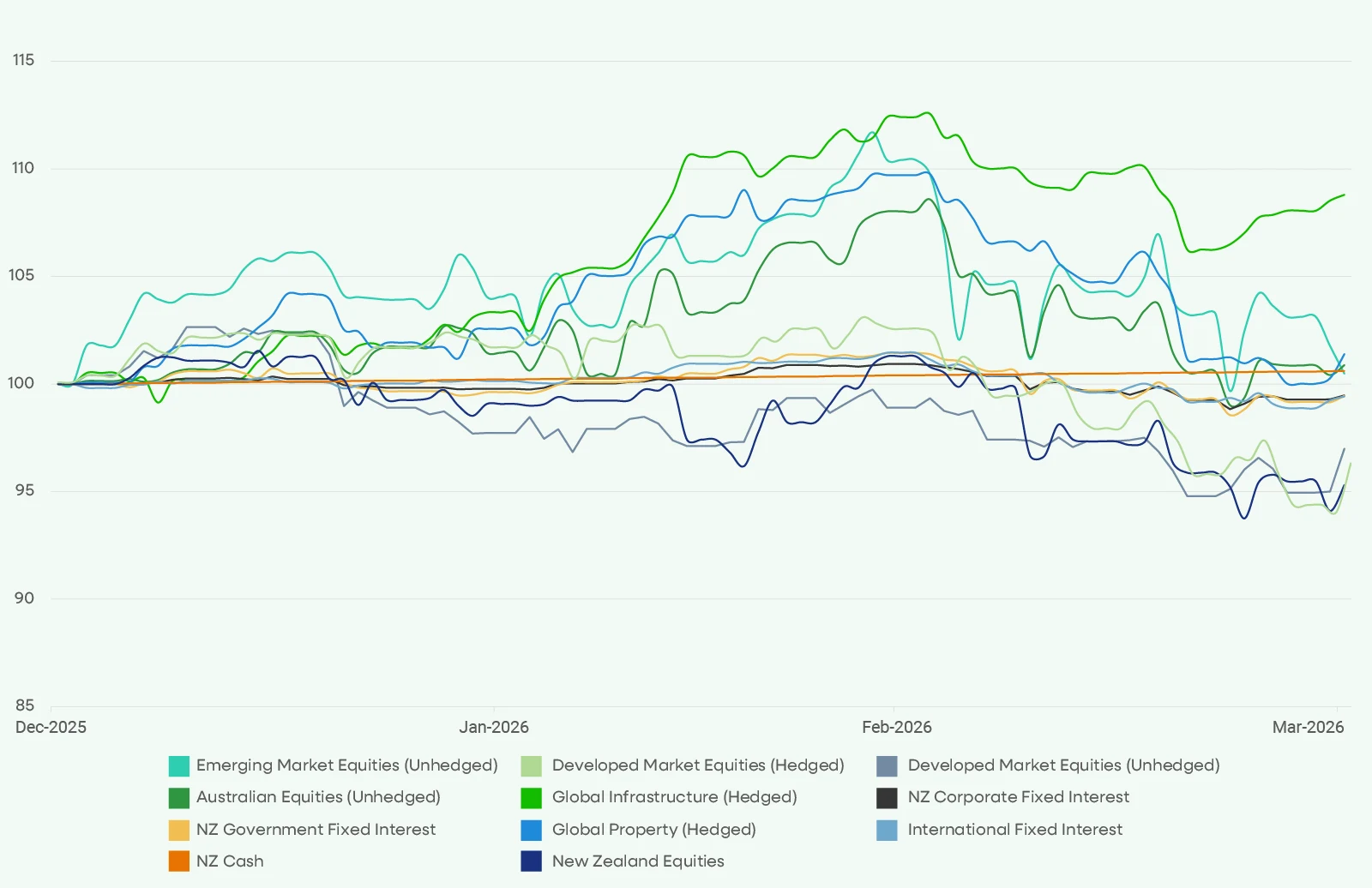
Source (Bloomberg)
Table 1: Major Asset Class Performance in NZD
Asset class | 3-month asset class return | 12-month asset class return |
|---|---|---|
Developed Market Equities (Hedged) | -3.7% | 16.9% |
Developed Market Equities (Unhedged) | -3.0% | 17.6% |
Emerging Market Equities (Unhedged) | 0.5% | 28.2% |
Australian Equities (Unhedged) | 0.9% | 18.0% |
New Zealand Equities | -4.7% | 5.2% |
Global Infrastructure (Hedged) | 8.8% | 14.9% |
Global Property (Hedged) | 1.4% | 5.1% |
International Fixed Interest | -0.6% | 2.0% |
NZ Corporate Fixed Interest | -0.5% | 3.9% |
NZ Government Fixed Interest | -0.5% | 3.8% |
NZ Cash | 0.6% | 3.1% |
Source (Bloomberg)
New Zealand and Australian Shares
The New Zealand share market dropped over the first quarter, with the S&P/NZX 50 down around 4.7% to the end of March. Larger companies held up better, while smaller companies saw a steeper decline.
More defensive areas like consumer staples and energy were more resilient, while technology, healthcare and materials were among the hardest hit. Tech stocks, Gentrack and Vista Group were both down around 28%, on average. Materials and healthcare also saw double-digit declines. In contrast, A2 Milk (up 8.2%) and Turners Automotive (up 7.8%) were standout performers, supported by strong earnings growth.
Australia followed a similar pattern, with the S&P/ASX 200 down 0.9% for the quarter. Technology stocks saw the largest declines dropping by 34%. Energy was one of the more resilient sectors, showing double digit returns with Woodside Energy and Karoon Energy as key contributors. Rising oil prices were the primary driver, as energy stocks continue to attract interest as an inflation hedge given the expectation that higher costs will be passed through to consumers.
Cash
The Reserve Bank of New Zealand held the Official Cash Rate steady at 2.25% in February signaling it was comfortable looking past recent inflation and continuing to support the economy. That changed quickly after the Middle East conflict. While the Bank has said it may look past short-term increases in petrol prices, markets now expect interest rates to rise sooner and more frequently, potentially reaching around 3% next year.
This reflects growing concern about inflation, even as economic growth remains relatively weak. While expectations may change, the focus has moved toward keeping inflation under control, rather than supporting growth.
NZ Fixed Interest
Bond yields rose over the quarter as inflation concerns increased, driven by higher oil prices. This pushed bond prices slightly lower.
At the same time, credit spreads widened - meaning investors demanded higher returns to lend to companies instead of governments, reflecting increased caution about risk. Despite this, higher overall yields have made bonds more attractive, helping to support demand in the local market. Overall, returns were slightly negative for both government and corporate bonds over the quarter, although underlying demand for credit remains relatively strong.
Global Fixed Interest
Global bond markets saw slightly negative returns over the quarter as investors adjusted to higher inflation expectations and increased risk following the conflict. Rising bond yields and market volatility were the main drivers. Overall, global bonds delivered modest negative returns for the quarter
Looking ahead
Markets are likely to remain volatile in the near term, driven by uncertainty around energy prices and investor confidence.
While this may keep inflation higher and slow growth slightly, it does not change the investment approach at this stage - staying diversified, keeping a long-term view, and avoiding reactive decisions based on short-term events.
This commentary is provided for general information purposes only and does not constitute personalised financial advice. Investors should consider their own circumstances and seek professional advice where appropriate.

Related articles
 The SuperLife KiwiSaver Scheme is becoming the Smart KiwiSaver Scheme. We’re building a better KiwiSaver experience, while keeping the things that matter the same.
 ![[object Object]](/_next/static/media/read.f0fe3afc.svg)
 Cutting through the noise to understand recent market events Marek Krzeczkowski, Head of Investment Strategy & Quant explores what recent market volatility means for investors.
  Why investing is so much easier than many Kiwis think Smart launched New Zealand's first ETF in 1996. Three decades later, CEO Lisa Turnbull says the barriers to investing have never been lower.